Conditional verdict: a small annual-budget app host
If you have not chosen the workload yet, start with the provider-neutral n8n VPS, local AI or WordPress guide; return here for RackNerd-specific terms.
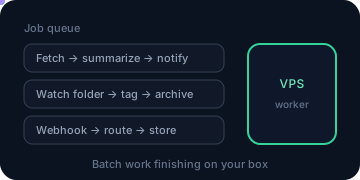
RackNerd earns a place on the shortlist when you want an inexpensive, always-on KVM for n8n, a lightweight website, or an AI-connected app—and you will operate Linux, constrain the workload, and build your own recovery. The annual KVM Specials combine full root access, one IPv4, SSD storage, a 1 Gbps port, and ctrl one-click apps. Their FAQ says the advertised special rate recurs for as long as you keep that service.
That combination is useful, not magical. The sampled specials top out at 8 GB RAM and 150 GB storage; ordinary KVM reaches 12 GB and 300 GB. “AI VPS” describes an app-deployment path, not a GPU inside the cheap plan. Managed VPS backups are not included by default. One-click installation erases the server. And refunds are discretionary rather than a routine money-back guarantee.
Buy the workload fit, not the annual price divided by twelve. If you need larger memory, provider snapshots, managed application support, many local-model users, or CUDA/VRAM, compare another architecture. The next decision is which RackNerd product you are actually buying.
Product map: standard, Specials, Ryzen, AI and GPU
RackNerd LLC sells VPS, dedicated, colocation and related infrastructure. Its About page names founder Dustin B. Cisneros and lists Inc. growth recognition; neither is an application-support test. The Terms identify a Delaware company with a California mailing address, not a guarantee that your VPS resides there.
Standard KVM VPS is the Intel Xeon/RAID-10 SSD ladder. It includes root access, KVM/ctrl, one dedicated IPv4, and a 1 Gbps port. Its public prices mix a 512 MB annual entry with monthly prices for larger tiers—do not infer an annual rate for the whole ladder.
KVM VPS Specials are separate annual offers with different disk/transfer allocations. The same-rate renewal statement belongs to these specials, not automatically to every RackNerd service. Preserve the selected offer, invoice and renewal terms.
Ryzen NVMe VPS trades capacity for a different CPU/storage platform. At the sampled 4 GB point, standard KVM lists 4 vCPU and 130 GB SSD; Ryzen lists 2 vCPU and 30 GB NVMe at the same displayed monthly price. That is a workload tradeoff, not proof that one is universally faster.
The AI VPS page directs buyers to Specials and ctrl apps such as n8n, Hermes Agent, AnythingLLM, Ollama/Open WebUI, LibreChat and OpenClaw. It does not establish a GPU-backed VPS family. Separate GPU dedicated servers exist in Salt Lake City, with sales-contact availability and a very different monthly budget. A legacy DDoS-protected special also exists separately; its sampled public order page showed zero stock and SolusVM, so do not transfer its protection or panel claims to ordinary Specials.
Prices and resources: record the cart you mean to buy
These are public examples checked 2026-11-05, not checkout quotes. Confirm currency, tax, total, region, stock, transfer, OS/app and renewal before paying.
| Standard KVM | vCPU | RAID-10 SSD | Transfer @ port | Displayed price |
|---|---|---|---|---|
| 512 MB | 1 | 30 GB | 500 GB @ 1 Gbps | $26.99/year |
| 1 GB | 2 | 50 GB | 1 TB @ 1 Gbps | $17.99/month |
| 2 GB | 3 | 75 GB | 2 TB @ 1 Gbps | $20.59/month |
| 4 GB | 4 | 130 GB | 3 TB @ 1 Gbps | $24.59/month |
| 6 GB | 5 | 170 GB | 4 TB @ 1 Gbps | $27.59/month |
| 8 GB | 6 | 220 GB | 5 TB @ 1 Gbps | $36.59/month |
| 12 GB | 7 | 300 GB | 6 TB @ 1 Gbps | $55.99/month |
Source: standard KVM and public order page.
| Annual special | vCPU | SSD | Transfer @ port | Annual example | Budget arithmetic only |
|---|---|---|---|---|---|
| 1 GB | 1 | 20 GB | 3 TB @ 1 Gbps | $21.99/year | $1.83/month |
| 2 GB | 2 | 35 GB | 5 TB @ 1 Gbps | $35.99/year | $3.00/month |
| 4 GB | 3 | 60 GB | 7 TB @ 1 Gbps | $59.99/year | $5.00/month |
| 6 GB | 6 | 100 GB | 12 TB @ 1 Gbps | $89.99/year | $7.50/month |
| 8 GB | 7 | 150 GB | 20 TB @ 1 Gbps | $119.99/year | $10.00/month |
Source: RackNerd Specials. The rightmost column is annual price ÷ 12, rounded; the contract and cash outlay remain annual. The standard monthly 2 GB plan is not equivalent to the 2 GB annual special in resources or price. Use the total-cost tool to add tax, external backups, model APIs, domains and migration overlap.
Locations and transfer: a footprint is not an inventory list
The homepage advertises 20 datacenter locations across North America, Europe and Asia. The datacenter directory is company-wide. The standard KVM page names 12 deployment areas; Specials merely promise multiple locations. Official detail pages explicitly listed VPS for Amsterdam, Ashburn, Atlanta, Chicago, Dublin, Los Angeles DC-03, San Jose, Seattle, Strasbourg and Toronto at research time. Dallas and New York illustrate why general marketing and detail pages should not substitute for the selected cart.
Choose region by users, integrations, legal requirement and measured route. Preserve the actual cart selection. If the workload has strict residency, IPv6 or DDoS requirements, obtain explicit confirmation for that SKU. Standard KVM mentions up to 100 IPv6 addresses on request in Los Angeles and France; that is not blanket IPv6 support.
All sampled KVM ladders show a 1 Gbps port and finite monthly transfer. The Specials display 3–20 TB depending on tier; standard/Ryzen differ. A port rate is neither guaranteed throughput nor unlimited data. The reviewed public material did not establish whether exhaustion leads to throttling, suspension or paid overage, so leave that field open until RackNerd confirms it.
Use RackNerd’s looking glass from the refund-help page before a long commitment. Record source network, target, date and several observations. One ping is not a speed score; a public status page reports node incidents, not an uptime benchmark.
ctrl: useful deployment controls, destructive shortcuts
The ctrl panel advertises power/rescue operations, HTML5 VNC, OS reinstall, root-password reset, resource meters, one-click apps and an optional provider-side inbound firewall. Its public demo explains that the ctrl layer and the guest firewall both apply. Keep console recovery available and configure both deliberately; the setup runbook gives a lockout-resistant sequence.
The app catalog is the operational reason to notice this product. n8n lists a 2 vCPU/2 GB minimum. Hermes, AnythingLLM, Ollama and LibreChat list 2 vCPU/4 GB; OpenClaw lists 4 vCPU/8 GB. Portainer, Coolify, CloudPanel, CyberPanel and WireGuard broaden the self-hosting path. These are installation floors, not production-capacity promises.
One-click is a fresh-image operation. RackNerd says it reinstalls Ubuntu and permanently erases the existing OS, applications and files, then shows credentials in ctrl. It is not an in-place app installer or an update button. Use a new/empty VPS, or stop until an occupied VPS has a verified off-server export and restore plan.
Support, fair use and recovery: the annual-price trade
RackNerd’s Specials are unmanaged. The Terms offer best-effort 24/7 infrastructure support for hardware, power, connectivity and availability. You own OS and application configuration, security, updates, firewalls, troubleshooting, data and backups. Paid management may be available by request; its price and scope were not verified. One-click does not make n8n or WordPress managed.
VPS users must keep CPU and disk-I/O use within fair share. Spam, mining, brute force, outbound DDoS and disruptive resource use are prohibited. Nested virtualization needs written approval; ordinary containers are expressly distinguished. AI agents do not get an exemption from anti-abuse or third-party permissions.
Section 7 of the Terms says VPS managed backups are not included by default absent a separate agreement. Shared/reseller JetBackup statements do not transfer to KVM. No general user-accessible KVM snapshot feature was established from the reviewed public pages; call that publicly unverified, not proof of absence. Either way, the recovery runbook starts with independent versioned exports and a restore drill.
The posted SLA promises 99.999% transit and power subject to exclusions and an account-credit formula, with claims inside 30 days and a monthly-fee cap. It is not an application SLA or data-recovery promise.
“I run X”: which RackNerd starting envelope?
These are editorial starting estimates, not RackNerd guarantees. Add OS, database, reverse proxy and recovery headroom to the app floor, then measure actual peaks.
| Workload | Starting envelope | Move up, split or leave when |
|---|---|---|
| Light n8n tests with API models | 2 GB special meets the listed n8n floor; bound concurrency/history | Database/proxy pressure, overlapping executions or large payloads; consider 4 GB |
| n8n + Postgres + connected AI tools | 4 GB, matching RackNerd’s production guidance | Persistent memory pressure, long queues or slow storage; separate inference before simply raising concurrency |
| Small WordPress or Coolify | 2 GB only after app/site budget; 4 GB gives more DB/proxy room | Uncached traffic, staging, backup overlap or multiple sites |
| Hermes/LibreChat/AnythingLLM | 4 GB; external model/API budget remains separate | Documents/vector store grow, users overlap or local inference joins the box |
| Small CPU Ollama experiment | 4 GB starting class; one deliberately small model and short context | Resident model + runtime + context + OS no longer leaves recovery margin |
| OpenClaw | 8 GB meets the listed 4 vCPU/8 GB floor | Tool workloads and containers compete, or sustained compute becomes the job |
| CUDA, large models, heavy media | Not an ordinary RackNerd KVM recommendation | Evaluate external APIs, larger Contabo capacity, GPU/dedicated hardware |
For the sizing arithmetic, resident memory is weights + context/concurrency + runtime + applications + OS/recovery margin. Stored model size is not resident memory, disk is not RAM, and swap is not VRAM. The AI-app guide turns this into preflight and smoke-test steps.
RackNerd versus Contabo: choose the constraint you accept
On the same research date, Contabo Core listed 8–96 GB RAM and 100–600 GB storage, with extension options. Its ladder is the more relevant comparison when a CPU-resident model, database, media scratch or several applications outgrow RackNerd’s small specials. That is a capacity observation, not a performance verdict.
Contabo also advertises included snapshots and optional Auto Backup. RackNerd’s default VPS terms put managed-backup responsibility on the customer. If provider-side rollback is decisive, do not let a low annual price erase that requirement. Conversely, RackNerd’s broad ctrl app catalog and recurring annual specials may better match a small, bounded deployment that you intended to back up independently anyway.
Network tradeoffs differ too: Contabo advertises unlimited fair-use traffic with tiered ports; RackNerd’s sampled plans show finite monthly transfer at 1 Gbps with unknown exhaustion handling. Neither fact establishes superior real-world throughput. Compare exact carts, currencies/tax, terms and measured routes rather than manufacturing a winner. See the Contabo review for its separate terms.
Recompute the real annual and exit cost
Suppose you choose the sampled 4 GB annual special for n8n plus an external model. The base arithmetic is $59.99 ÷ 12 = $5.00 per month, but the cash charge is $59.99 for the year before any checkout tax. Add your backup repository, domain/DNS if not already owned, model usage and a migration overlap month. If those add $12/month on average, the infrastructure-plus-operations budget is $17/month—not the $5 headline.
For a concrete worksheet, let B be backup cost and M be model/API cost per month, and let T be checkout tax for the year. The first-year estimate is $59.99 + T + 12 × (B + M), excluding optional domain and migration costs. With illustrative B=$3, M=$9, and T=$0, that is $203.99/year, or $17.00/month in budget arithmetic. Replace every assumption with your own usage; none of these add-ons is a RackNerd quote.
The 2 GB special looks cheaper at $35.99/year, but a forced migration after an out-of-memory incident can erase that saving. Compare the cost of adequate headroom with the cost of operator time and downtime. Likewise, Contabo’s larger capacity may cost more while replacing separate backup or inference machinery; calculate complete carts.
There is no standard monthly cash-flow interpretation of an annual special. Cancelling auto-debit does not convert it into monthly service, and the default no-refund posture means unused months should not be treated as recoverable. Record the renewal date, then use the total-cost tool and lifecycle ledger to keep both cash and exit costs visible.
When not to recommend RackNerd
Do not choose this route when you need a provider to administer n8n, Ollama, WordPress or restores; when the workload requires CUDA/VRAM, sustained full CPU, large context/model collections or many simultaneous users; or when one node and a credit-based infrastructure SLA cannot meet your recovery objective.
Also pause if you expect a routine refund, require provider snapshots, or cannot verify a mandatory region/network condition. The billing guide covers the five-day ordinary cancellation notice, seven-day contract-service rule and immediate-versus-end-of-cycle distinction. Removing auto-pay is not cancellation.
Procurement worksheet before payment
Copy this ledger and answer every line from the selected public cart or explicit support clarification:
Product family / exact SKU:
Checkout URL and access date:
Region and stock actually shown:
vCPU / RAM / storage type and capacity:
Monthly transfer / port / exhaustion policy (or UNKNOWN):
IPv4 / IPv6 / DDoS terms for this SKU:
OS / one-click app / panel:
Initial total / currency / tax / term:
Renewal total and same-rate evidence:
Auto-debit behavior for my payment method (or UNKNOWN):
Refund / cancellation deadline:
Provider backup or snapshot evidence (or UNVERIFIED):
Off-provider backup destination and monthly cost:
External model/API monthly budget:
Migration overlap budget:
Workload limit that makes me split or leave:
Your next stop is safe ctrl setup for a fresh VPS, AI sizing for model architecture, n8n operations after installation, or billing and recovery before committing important data.
A 30-day acceptance plan for the annual commitment
Do not wait until renewal to discover that the host is wrong. During the first day, preserve the order evidence and complete the setup inventory. During the first week, run one representative workload, cap its concurrency/history, verify all exposed ports, and perform the first isolated restore. During the first month, observe ordinary—not artificially saturated—CPU, RAM, disk and transfer use while real workflows run.
Keep a dated capacity ledger with four values: peak application memory, free root-filesystem space, execution/queue delay, and monthly transfer shown by the provider. Add the cost of the external model API and off-provider repository. If you cannot measure a value, mark it unknown rather than substituting a marketing figure.
Set three explicit exit triggers before the annual fee feels “sunk”: repeated resource failure after limits are tuned, a recovery drill that cannot meet your RTO/RPO, or an unmet region/network/support requirement. A same-rate renewal is valuable only while those conditions remain satisfied. This plan also produces the evidence needed for a reasoned discretionary refund or support discussion, without promising that RackNerd will approve one.
Questions worth sending before a special case
Generic pre-sales questions produce generic reassurance. If your decision depends on a fact absent from the public pages, ask about the selected SKU and region: “What happens when this exact plan reaches its monthly transfer allocation?” “Is this exact plan available with the required IPv6/DDoS terms?” “Does this exact service have a customer-accessible snapshot feature, and what is its restore scope?” “Which upgrade path preserves this annual special’s renewal price?”
Save the dated answer with the order. A support reply can clarify a purchase, but it does not replace the written contract, an off-provider backup, or an application test. For auto-debit and cancellation, inspect the actual client area as well. For a strict deployment requirement that remains unanswered, choose a provider whose documentation already satisfies it.
Sources and updates
Primary RackNerd sources are linked beside each claim: standard KVM, Specials, Ryzen, AI VPS, ctrl, Terms, SLA and datacenters. All checked 2026-11-05. Editorial boundaries (including what we do not invent) live on About.